Frankincense Essential Oil: What the History and Research Actually Tell You
Here’s what bothers me about how frankincense gets talked about in the natural wellness world.
It’s either positioned as a near-miraculous substance that ancient civilizations knew held the secret to everything — or it gets lumped in with the rest of the “essential oils as pseudoscience” dismissal that you’ll find in every skeptic’s corner of the internet. Neither of those framings does it justice.
The truth is more interesting than either version.
Frankincense has one of the longest documented histories of human use of any substance on earth — not just decades, not even centuries, but thousands of years across dozens of cultures on multiple continents. That kind of durability isn’t coincidence. And in the last two decades, researchers have started asking why — with some genuinely surprising results.
There are real limitations to what the current research tells us. There are also real reasons to pay attention to what it’s starting to show.
I want to walk you through both, honestly. No hype, no dismissal. Just what I’ve learned — and why I think frankincense is worth understanding deeply if you’re serious about natural wellness.
Where It Comes From

The trees that give us frankincense — primarily Boswellia sacra, Boswellia carterii, and Boswellia serrata — are ancient, slow-growing, and remarkably resilient. They grow in some of the harshest terrain on the planet: the rocky hillsides of Oman and Yemen, the dry forests of Somalia and Ethiopia, the arid regions of India. They thrive, almost improbably, in soil so poor that little else survives alongside them.
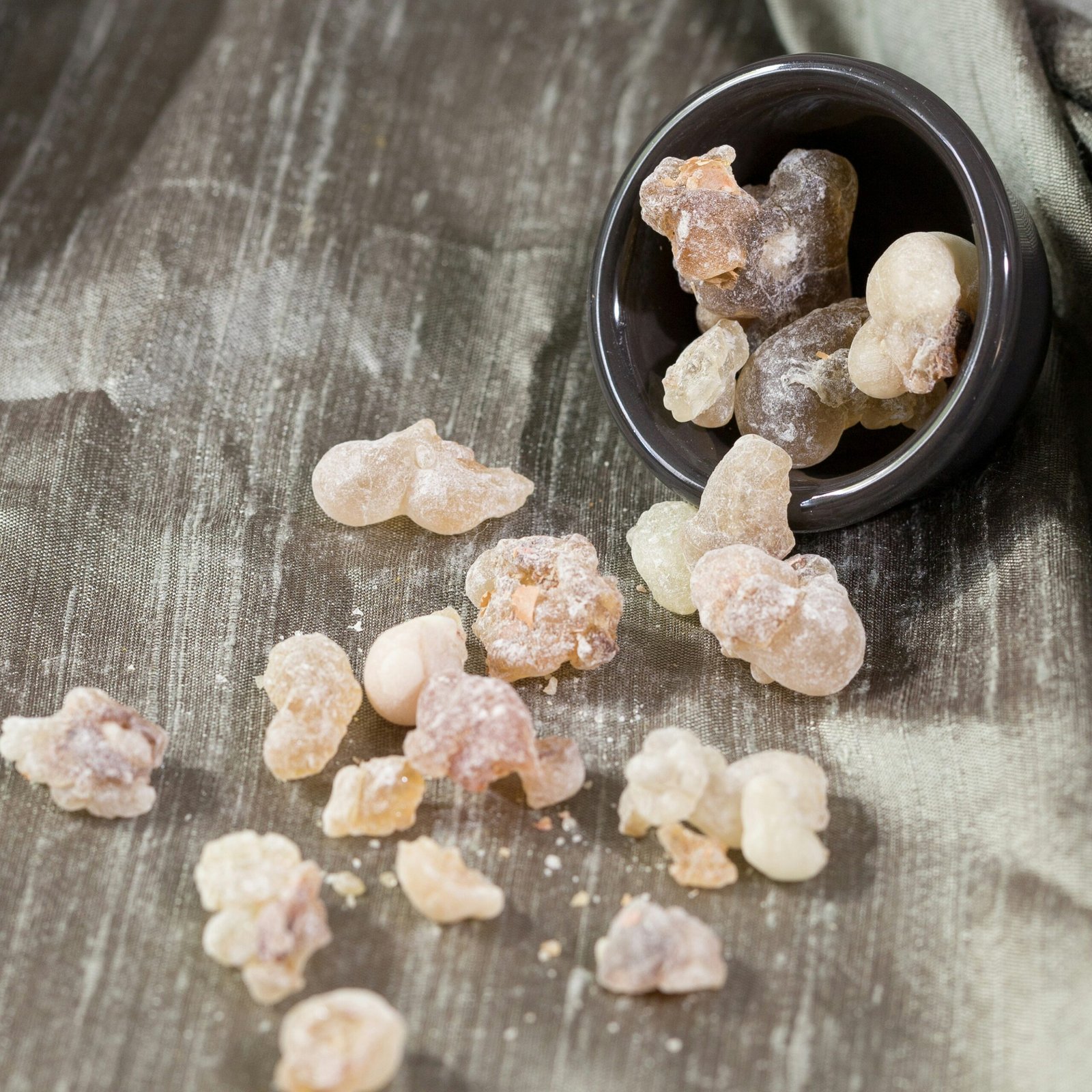
To harvest the resin, workers cut shallow grooves into the bark. The tree responds by bleeding — a thick, milky sap that hardens on contact with air into small, teardrop-shaped lumps called “tears.” Those tears are collected by hand, dried, and either burned as incense or steam-distilled into the essential oil we use today.
The trade routes that carried frankincense out of southern Arabia and the Horn of Africa to the ancient world were among the most economically significant in history.
For centuries, the Incense Route was as lucrative as any spice road — frankincense moved by camel caravan across more than a thousand miles of desert to reach Egypt, Greece, Rome, and beyond. Cities like Petra and Ubar were built on the wealth it generated.
It was, in the most literal sense, worth its weight in gold.
The Egyptians used it in embalming and in religious ceremonies. The Greeks burned it at every significant ritual. Romans used it in state funerals and temple rites. The Hebrews included it in the sacred incense burned in the Tabernacle. It appears in the oldest medical texts we have — the Ebers Papyrus, written around 1550 BCE, references Boswellia resin as a treatment for a range of conditions.
And then there’s the obvious — it’s one of the three gifts brought to Bethlehem, an offering considered worthy of a king.
That’s not mythology. That’s history. And the breadth of it across unconnected cultures suggests these weren’t people being fooled by a pleasant smell. They were observing something real.
What Does Frankincense Actually Smell Like?
If you’ve ever walked into a cathedral and caught that ancient, smoky, slightly sweet smell rising from a censer — that’s frankincense. Or at least, it’s frankincense resin being burned, which produces a slightly different character than the distilled essential oil.
The oil itself is more nuanced than the incense smoke. It opens with a bright, almost citrusy top note — clean and slightly sharp, which surprises most people who expect something heavier. Then it settles into the resinous heart: warm, balsamic, woody, with a depth that feels both ancient and calming. There’s a subtle earthiness underneath — not damp or musty, but dry and grounding, like old stone or warm wood.
It’s the kind of scent that slows you down. Not in a sedating way — more in the way of a deep, involuntary exhale.
Some people pick up a frankincense note that’s almost medicinal — a cool, slightly camphorous quality, depending on the species and origin. Boswellia sacra from Oman tends to be cleaner and more citrus-forward. Boswellia serrata from India often presents richer, denser, and more resinous. Origin matters with this oil more than most.
It blends beautifully with lavender, myrrh, cedarwood, sandalwood, and orange. In a diffuser blend, it’s one of those oils that makes everything else smell more intentional — a grounding note that lifts the whole composition without dominating it.
What’s Actually in It?
This is where it gets interesting — and where I want to be precise, because the chemistry of frankincense is one reason it keeps showing up in research labs.
The essential oil produced by steam distillation contains primarily monoterpenes — particularly alpha-pinene, limonene, and para-cymene — along with sesquiterpenes like incensole acetate. The exact profile varies significantly by species and geographic origin, which matters when you’re reading studies and trying to understand what’s being tested.
Alpha-pinene is the dominant constituent in many frankincense oils, often making up 40–65% of the total composition. It’s also found in pine, rosemary, and eucalyptus.
Research suggests alpha-pinene has anti-inflammatory properties and may support respiratory function. It’s also being studied for its potential effects on memory and alertness — one small study found that airborne alpha-pinene reduced acetylcholinesterase activity in ways that may support cognitive function, though that research is still early.
Limonene — also abundant in citrus oils — appears in frankincense and contributes to that bright, uplifting top note. It’s one of the more studied terpenes in the broader research literature, with a range of investigated properties including immune modulation and mood support.
Incensole acetate is a compound found specifically in frankincense — particularly Boswellia sacra — that has attracted serious scientific attention. A notable study published in The FASEB Journal in 2008 found that incensole acetate activated TRPV3 channels in the brain associated with warmth and the regulation of emotions. The researchers suggested this mechanism might help explain why burning frankincense has been associated with spiritual and mood-affecting experiences across cultures for millennia.
That last point deserves some careful framing.
A single animal study, even a compelling one, is not a clinical conclusion. But it is a credible opening into a question that deserves more investigation than it’s received.
Here’s something important to understand: the resin itself also contains boswellic acids, compounds that have been far more extensively studied — particularly AKBA (acetyl-11-keto-β-boswellic acid). Boswellic acids are not present in the steam-distilled essential oil in meaningful quantities, because they’re large molecules that don’t survive the distillation process.
Much of the most robust frankincense research you’ll encounter — including clinical studies on joint health and inflammation — was conducted using Boswellia resin extracts or supplements, not the essential oil.
I want to be direct about this because it matters.
When people talk about frankincense research, they’re often citing studies on oral Boswellia extracts — not the oil. Some of those benefits may translate; the aromatic and topical compounds in the oil have their own profile of investigated properties. But they’re not interchangeable, and an honest read of the science means making that distinction clearly.
What People Use Frankincense Oil For
Let’s start with the big picture, and then I’ll be straight with you about where the evidence is strong and where it’s thinner.
Skin care and cellular support is probably where the essential oil has the most user consensus and the most plausible research basis.
Frankincense has been used topically for centuries to support healthy-looking skin — and there’s reasonable science behind why. Alpha-pinene and other constituents have demonstrated anti-inflammatory and antimicrobial properties in laboratory studies.
Many people use a diluted frankincense oil as part of a daily skin routine, particularly for aging or dry skin, and the reported results — improved tone, reduced appearance of fine lines, a general improvement in skin quality — are consistent enough across the community to be worth taking seriously.
This is not the same as saying it’s clinically proven to do any of those things. But “plausible mechanism + longstanding traditional use + consistent anecdotal evidence” is exactly the kind of convergence a thoughtful person pays attention to.
Mood and emotional support is an area where the incensole acetate research becomes relevant.
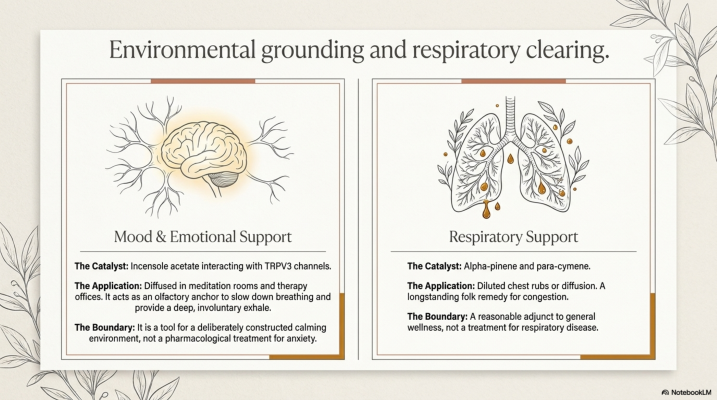
The practical version: a lot of people find diffusing frankincense genuinely grounding. It’s a common feature of meditation rooms, therapy offices, and quieting-down routines for a reason.
Whether that’s primarily pharmacological, primarily olfactory conditioning, or some combination of both — the effect on mood and sense of calm is reported widely enough that it’s worth including here.
What I won’t do is claim it treats anxiety or depression. It doesn’t belong in that sentence. But as part of a deliberately constructed calming environment — alongside intentional breathing, reduced stimulation, or a quiet morning — it seems to contribute something real.
Respiratory support is another traditional use with some chemical backing.
Alpha-pinene and para-cymene both have investigated properties relevant to respiratory health.
Diffusing frankincense or applying it diluted to the chest is a longstanding folk remedy for congestion and breathing support, and the constituent profile gives that use some plausibility. Again — not a treatment for respiratory disease. But a reasonable adjunct to general respiratory wellness.
Immune support is an area where frankincense often gets promoted with more confidence than the current evidence in the essential oil literature supports. The boswellic acid research on immune modulation is genuinely interesting — but that research, as noted above, is largely on oral resin extracts, not the oil. I’m not dismissing the possibility that aromatic or topical use has immunomodulatory effects — the mechanisms exist — but I’d want to see more specific research before making strong claims here.
Spiritual and ceremonial use. This one doesn’t need hedging, because it’s simply historical fact. Frankincense has been burned in religious and ceremonial contexts for more than five thousand years.
If you use it in a meditation session, a quiet evening ritual, or a moment of intentional reflection, you’re participating in one of the oldest human traditions we have documented record of. That’s not a wellness claim. That’s just true.
How to Use It Safely
Frankincense is one of the gentler oils in the essential oil world — but gentle doesn’t mean careless.
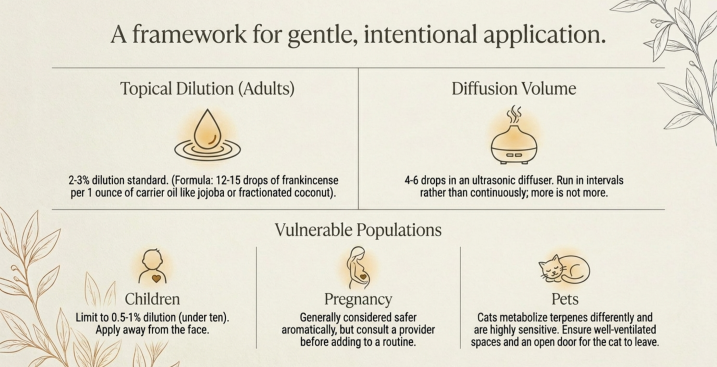
For topical use, a dilution of 2–3% is appropriate for most adults. That works out to roughly 12–15 drops per ounce of carrier oil.
Jojoba, rosehip, and fractionated coconut oil are excellent carriers for skin applications.
Rosehip in particular, pairs well with frankincense for facial use, since it brings its own skin-supporting properties.
Always do a patch test before applying to a larger area, even with an oil this well-tolerated.
For diffusion, 4–6 drops in a standard ultrasonic diffuser is plenty. Frankincense is potent aromatically — more is not more. Run your diffuser in intervals rather than continuously, especially in smaller rooms.
Pregnancy: Frankincense is generally considered one of the safer oils for use during pregnancy in aromatic applications at low concentrations, but it’s always worth discussing with your midwife or healthcare provider before adding any essential oil to your routine during pregnancy or while nursing.
Children: Use more conservative dilutions — 0.5–1% for children under ten. Aromatic diffusion at low concentrations is generally well-tolerated. Topical application should be limited to areas away from the face for young children.
Pets: Cats, in particular, metabolize terpenes differently than humans and can be sensitive to diffused oils. If you have cats in the home, diffuse in ventilated spaces, keep sessions short, and make sure your cat has the option to leave the room.
One quality note: frankincense is unfortunately one of the more commonly adulterated oils on the market, given the expense and labor intensity of genuine resin harvest. The species sourced, the geographic origin, and the distillation process all affect the final oil’s profile significantly.
This is one of the places where Young Living’s Seed to Seal process earns its relevance for me — knowing the sourcing standards and testing protocols behind the oil I’m using matters more with frankincense than with almost any other oil in my collection.
Some Blends Worth Trying
Deep Grounding Diffuser Blend
For morning focus or an evening wind-down ritual
- 3 drops frankincense
- 2 drops cedarwood
- 2 drops lavender
This is a quieting blend — warm, woodsy, and settling. It works well as an anchor for a journaling session or a meditation sit.
Skin Support Serum
For facial or décolletage application
- 1 oz (30ml) rosehip seed oil
- 8 drops frankincense
- 4 drops lavender
- 3 drops myrrh
Shake before use. Apply a few drops to clean skin morning or evening. The rosehip and myrrh both bring complementary skin-supporting properties that work well alongside frankincense.
Grounding Roll-On
For pulse points — wrists, temples, or the back of the neck
- 10ml roller bottle filled with fractionated coconut oil
- 6 drops frankincense
- 3 drops orange
- 2 drops sandalwood
Roll on before a high-stakes meeting, a stressful commute, or anytime you need a moment of reset. The orange lifts it just enough to keep it from being heavy.
Chest Rub Blend
For seasonal respiratory support
- 1 oz carrier oil (jojoba or coconut)
- 8 drops frankincense
- 5 drops eucalyptus
- 3 drops lavender
Apply to the chest and upper back. The alpha-pinene in the frankincense and the eucalyptol work in the same general direction — this is a traditional combination with a reasonable chemical rationale behind it.
Questions People Ask About Frankincense
Q: Is frankincense really anti-inflammatory, or is that just wellness marketing?
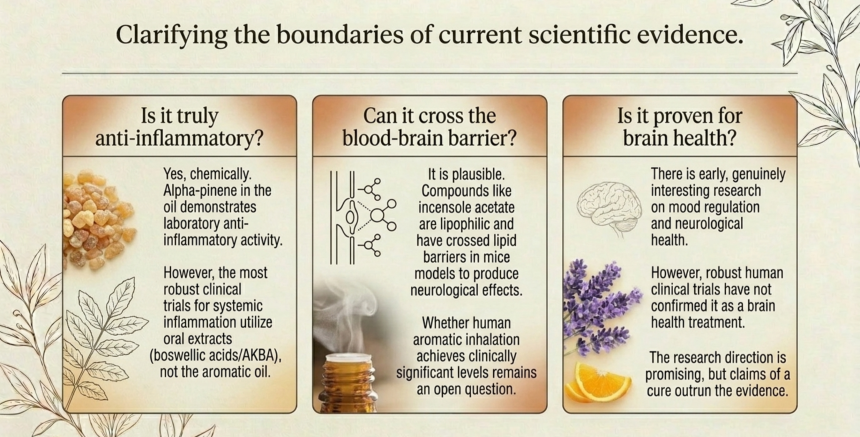
The most rigorous anti-inflammatory research on Boswellia has been conducted using oral resin extracts — particularly AKBA — not the essential oil. That research is genuinely compelling, especially for joint health, and several clinical trials have produced positive results. For the essential oil specifically, the monoterpenes (particularly alpha-pinene) have demonstrated anti-inflammatory activity in laboratory studies. So the underlying claim has a real chemical basis — but the strength of the evidence depends heavily on which form of frankincense you’re talking about. If you’re looking for the most researched delivery method for systemic inflammation support, a quality Boswellia supplement is where the clinical trial literature is concentrated. The oil is better understood as a topical and aromatic tool with its own valid, if less clinically tested, profile of properties.
Q: You mentioned different Boswellia species. Does the species actually matter when I’m buying the essential oil?
Yes — meaningfully so. Boswellia sacra (from Oman and Yemen) and Boswellia carterii (from Somalia and Ethiopia) are the most commonly sourced for essential oil production and tend to be clean, citrus-forward, and high in alpha-pinene. Boswellia serrata (from India) is the species most studied in the clinical literature for its boswellic acid content — but again, those acids aren’t present in the distilled oil in significant quantities. When you’re buying frankincense oil, look for the Latin species name on the label. A supplier that can’t tell you the species is a supplier you should probably pass on.
Q: I’ve read that frankincense can cross the blood-brain barrier. Is that true?
Some of the compounds in frankincense oil — particularly incensole acetate and certain small terpene molecules — are lipophilic, meaning they can potentially cross lipid-based barriers including the blood-brain barrier. The incensole acetate research I mentioned earlier (the 2008 FASEB Journal study) showed neurological effects in mice via this kind of mechanism. Whether aromatic inhalation of frankincense oil delivers enough of these compounds to produce clinically significant neurological effects in humans is an open question. The pharmacokinetics of inhaled terpenes in humans are still being studied. It’s a plausible mechanism. It’s not a confirmed human clinical outcome. Both of those things are true simultaneously.
Q: What’s the difference between frankincense resin, frankincense tears, and the essential oil? Am I getting the same benefits from each?
No — they’re meaningfully different. The raw tears (hardened resin) are what’s traditionally burned as incense, releasing aromatic compounds through combustion. The essential oil is produced by steam distillation of the resin, which captures the volatile aromatic compounds — primarily terpenes — but leaves behind the larger, heavier molecules like boswellic acids. Oral Boswellia extracts and supplements retain those boswellic acids, which is why the anti-inflammatory research has concentrated there. Each form has its own valid uses; they’re just not interchangeable. If you’re using the oil and reading research on Boswellia supplements and assuming you’re getting the same outcome, that’s a gap worth being aware of.
Q: Is there any solid research on frankincense and brain health?
There is early, genuinely interesting research — and I want to describe it accurately rather than overstate it. The incensole acetate work suggested mechanisms relevant to mood regulation. There are also some preliminary studies looking at Boswellia compounds in the context of neurological health more broadly. None of this has cleared the bar of robust human clinical trials yet. It’s an active area of investigation, not a settled conclusion. Anyone claiming frankincense is a confirmed brain health treatment is getting ahead of what the evidence currently supports. Anyone dismissing the research direction entirely isn’t reading the same studies I am.
Q: How do I know if a frankincense oil is genuine or adulterated?
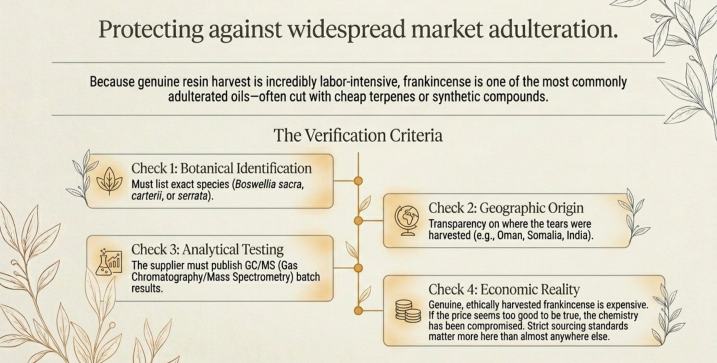
This is one of the most important questions you can ask, and it doesn’t have a simple answer. Adulteration in frankincense oil is common — cutting with cheaper terpenes, substituting lower-grade species, or extending with synthetic compounds. The things that help: buying from suppliers who publish their GC/MS (gas chromatography/mass spectrometry) test results, knowing the species and origin you’re getting, and being skeptical of unusually low price points. Genuine frankincense from quality sources is not cheap. If the price seems too good, it usually is.
A Final Thought
Here’s what I keep coming back to with frankincense.
Five thousand years is a long time for something to stay in continuous use across unconnected cultures. Civilizations that had nothing in common — not language, not religion, not geography — all independently found their way to this particular resin and kept reaching for it. That doesn’t prove anything about the oil’s chemistry. But it does suggest that the people doing the reaching weren’t being fooled.
The modern research is catching up slowly.
Some of what it’s finding is genuinely compelling. Some of the popular wellness claims outrun what’s actually been demonstrated. A serious person — one who reads carefully and thinks critically — can hold both of those things at once.
That’s where I try to land with frankincense. Respect for the history, honesty about the science, and a willingness to work with something that may still have more to teach us than we’ve formally confirmed yet.
For more guides, blends, and deep dives, head over to oilsforliving.us — it’s built to be the resource I wished I had when I was starting out.
A quick note before you go: I’m not a doctor or certified aromatherapist — just someone who’s done a lot of reading and a fair amount of experimenting. Nothing in this article should be taken as medical advice. Essential oils are powerful and worth learning about, but if you have a health condition you’re managing, please talk to a qualified healthcare provider before adding anything new to your routine. Always dilute before applying topically, and do a patch test first.
— Max