How One Citrus Oil Became the First Thing I Reach for Every Morning
There’s a moment right between waking and rising. The room is still quiet. The mat is in the corner. The day hasn’t asked anything of you yet.
That moment used to feel fragile to me. Like something I had to protect before the noise rushed in.
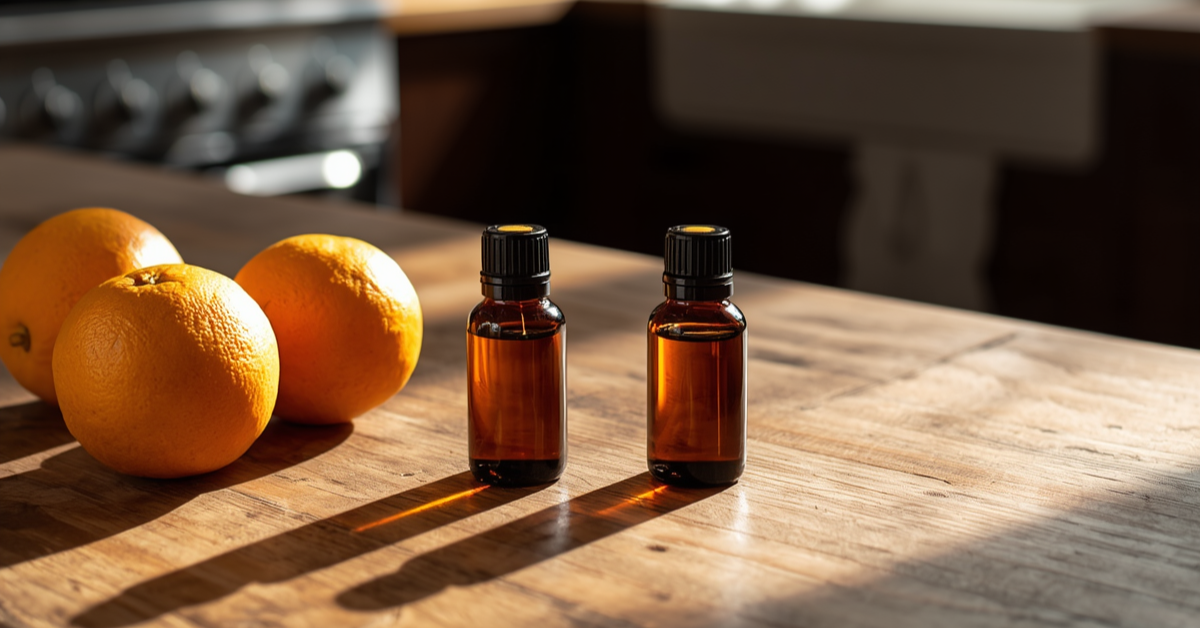
So I added one small thing. One drop of orange essential oil — rubbed between my palms, cupped over my face, three slow breaths. That’s it. And something shifted. Not dramatically. Not in a way I could easily explain to someone who hadn’t tried it. But consistently, quietly, in a way that stuck.
I’ve been writing about essential oils long enough to know that “simple” doesn’t mean “uninteresting.” Orange is proof of that. The more I dug into its history, its chemistry, and the growing body of research around it, the more I understood why this cheerful, unpretentious little oil has been treasured for over four thousand years.
What follows is everything I’ve learned. The history, the science, the safety, the blends, and — if you’re ready to take it seriously — how to choose an oil that’s actually worth your trust.
Where It Comes From
Cold-pressed from the outer peel of Citrus sinensis — the sweet orange — this oil has roots that go back further than most people realize.
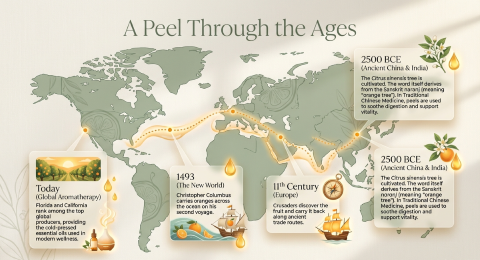
The orange tree was cultivated in ancient China and India as far back as 2500 BCE. Some of the earliest written references appear in Chinese texts dating to around 2200 BC. In Traditional Chinese Medicine, orange peel was used for over four thousand years to address digestive complaints, soothe coughs, and support overall vitality.
Folk healers across the Mediterranean, the Middle East, and India reached for it long before the word “aromatherapy” existed. The 17th-century English herbalist Nicholas Culpeper praised oranges for their ability to “refresh the heart” — a sentiment that still resonates.
Europe didn’t encounter the orange until the 11th century, when Crusaders carried it back along ancient trade routes. By the 15th and 16th centuries, Spanish and Portuguese explorers had introduced it to the New World. Christopher Columbus carried oranges on his second voyage in 1493.
Today, Florida, California, Brazil, Italy, and Spain rank among the world’s major producing regions. The cold-pressed oil extracted from their peels has earned a permanent place in modern aromatherapy — and in my morning routine.
One detail I find genuinely fascinating: the color orange was named after the fruit, not the other way around. That didn’t happen until sometime in the 16th century. The fruit came first. Everything else followed.
What Does Orange Actually Smell Like?
Bright. That’s the first word.
Bright the way sunlight through a window is bright — not harsh, not overwhelming. Just immediately present.
It’s sweeter than lemon and rounder than grapefruit. There’s warmth underneath the initial burst — something almost like the white pith of the fruit itself. Soft. Slightly creamy. On the skin it dries down quickly and leaves a subtle sweetness closer to fresh-squeezed juice than candy.
That quality matters for a morning ritual. It doesn’t compete with silence. It doesn’t announce itself the way peppermint does. It invites. It opens. It smells like the beginning of something good.
What’s Actually in It?
The oil is extracted through cold pressing — the peel is mechanically pressed to release its aromatic, oil-rich compounds. No heat is applied. That matters, because heat degrades the chemistry. Cold pressing preserves the vibrant complexity that makes orange oil work.
The result is a light, bright oil that is both uplifting and calming — often at the same time. Here’s why.
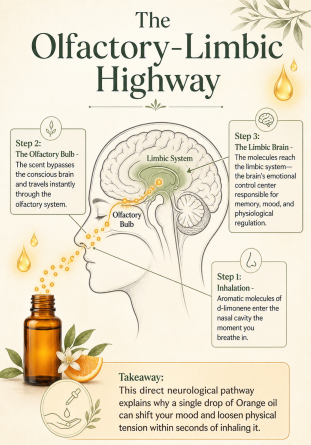
D-limonene is the dominant compound, typically making up more than 90% of the oil. It’s a naturally occurring monoterpene that travels quickly through the olfactory system to reach the limbic brain — the emotional center responsible for memory, mood, and physiological regulation. That’s the mechanism behind the experience. When you inhale orange oil and something shifts within seconds, limonene is doing the work.
Research bears this out, and I’ll cover that in a moment…
Myrcene shows up in smaller amounts — a subtle earthy undertone beneath the brightness. Found also in hops and lemongrass, it’s associated with mild calming properties in traditional plant medicine, though clinical research here is still emerging.
Alpha-pinene appears in trace amounts. Same compound found in pine and rosemary. Early research links it to alertness and mental clarity — which may partly explain why orange manages to feel both grounding and energizing at the same time.
The chemistry gives you the “why.” The experience keeps you coming back.
What the Research Actually Says
I want to be honest about the evidence here, because I think the oils world often overclaims — and that does everyone a disservice. So let me walk through what the research actually shows, and where the limits are.
Anxiety and stress reduction is where the evidence is strongest.
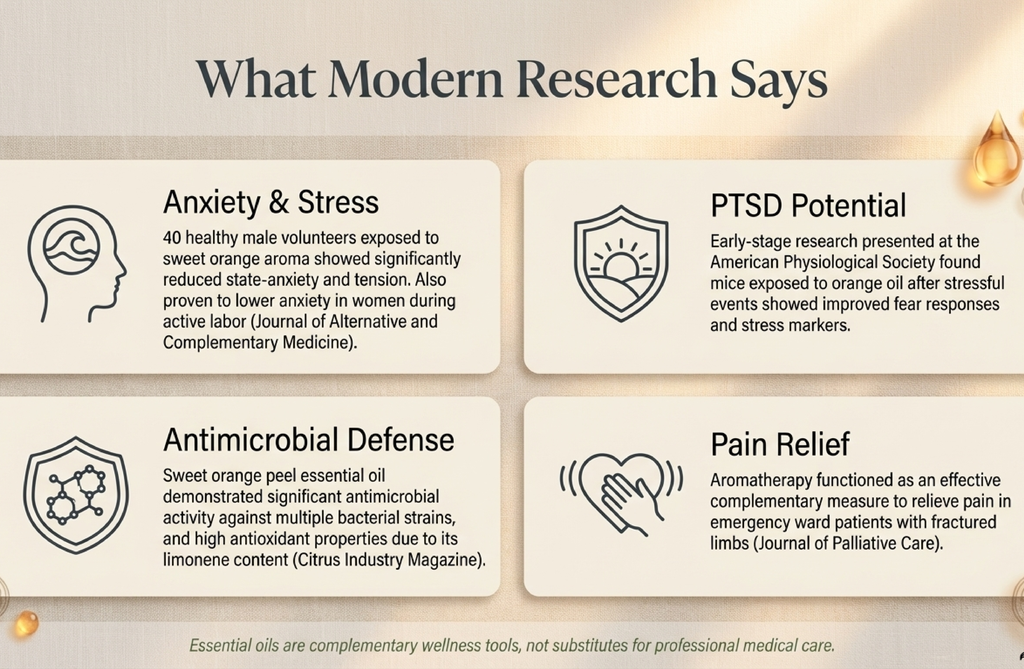
A peer-reviewed study published in the Journal of Alternative and Complementary Medicine tested the effects of sweet orange aroma on 40 healthy male volunteers. Those exposed to orange essential oil showed significantly reduced state-anxiety and subjective tension throughout an anxiety-provoking situation, compared to control groups.
The researchers concluded there was genuine anxiolytic activity — scientific language for anxiety-reducing.
That’s not a one-off finding.
A separate randomized clinical trial found that women in active labor who inhaled orange essential oil reported significantly lower anxiety levels than those who inhaled distilled water.
And in 2013, a study found that aromatherapy with orange essential oil reduced pulse rate and stress hormone levels in children undergoing dental procedures.
These aren’t enormous, definitive trials. But the pattern is consistent — and that matters.
PTSD research is earlier stage but worth watching.
A study presented at the American Physiological Society’s Experimental Biology meeting found that mice exposed to orange essential oil after stressful situations showed improvements in fear response and immune markers of stress.
The researcher noted the potential for passively inhaling the oil to ease PTSD symptoms in humans. Human clinical trials haven’t confirmed this yet — but it’s a promising line of inquiry.
Antimicrobial and antioxidant properties are also documented.
Another study published in Citrus Industry Magazine –found that sweet orange peel essential oil demonstrated significant antimicrobial activity against multiple bacterial strains.
Limonene is recognized in peer-reviewed literature for antioxidant and anti-inflammatory properties. A 2024 review also noted that orange essential oil may positively affect intestinal microbiota in animal studies.
Human research here is still emerging.
Pain relief rounds out the picture.
A randomized clinical trial published in the Journal of Palliative Care found that aromatherapy with orange essential oil could help relieve pain in emergency ward patients with fractured limbs — functioning as a complementary measure alongside conventional care. Preliminary. Limited in scope. But worth noting.
The bottom line: orange essential oil is not a cure for anything.
But the evidence that it does something real — particularly for mood and anxiety — is more solid than most people expect from a citrus oil.
What People Use Orange Essential Oil For
Orange is known, first and foremost, as an emotional oil. That’s not a dismissal — it’s a distinction worth making. Some oils work primarily on the body. Orange works primarily on the mood. For anyone who takes their inner life seriously, that’s not a small thing.
Upliftment and anxiety relief is the core use — and the one with the strongest research backing.
Diffusing orange during meditation, breathwork, or quiet morning time creates what many practitioners describe as an emotional reset. A signal to the nervous system that the space is safe, the pace is slower, the day hasn’t won yet.
Focus and mental clarity is the quieter benefit.
Not the sharp, aggressive focus of peppermint — something softer. More open. The kind of attention that’s useful when you’re trying to arrive fully before you begin moving.
Spiritual and devotional use deserves its own mention.
Orange has a long history in contemplative traditions — diffused in meditation spaces, applied to pulse points before prayer or quiet reflection, blended into rituals meant to encourage presence, gratitude, and openness.
Many people in intentional communities describe it as an oil that “opens the heart.” That’s not something I can put in a research citation — but I can say it matches my experience.
Seasonal mood support is something a lot of people in the oils world reach for.
When natural light is scarce and mood dips quietly — not quite seasonal depression, but not quite fine either — orange diffused in a dim room does something genuinely useful. It mimics brightness in a small but real way.
Skin support is worth knowing about.
Even if it’s not the first reason most people reach for orange. Its high limonene content is recognized for antioxidant, anti-inflammatory, and antibacterial properties.
When properly diluted, it’s used in facial serums to help brighten complexion, minimize the appearance of dark spots, and support a more even skin tone.
Always dilute carefully for facial use — more on that below.
Natural household cleaning is a practical application many people overlook.
Orange oil’s antimicrobial properties make it a genuinely useful addition to DIY surface sprays. It bridges the gap between wellness routine and natural home — without smelling clinical.
And then there’s something harder to categorize…
Call it presence in ritual.
Orange has a way of marking a moment. Use it consistently in your morning routine and your nervous system starts to associate the scent with that state of openness and intention. One inhale becomes a shortcut. A sensory cue that says: this is the time. This is the work. We’re here now.
That’s not placebo. That’s olfactory memory. And it’s one of the most powerful tools in any intentional morning routine.
How to Use It Safely
Orange is one of the gentler oils — but gentle doesn’t mean careless.
For topical use, dilute to the right level for your intended application:
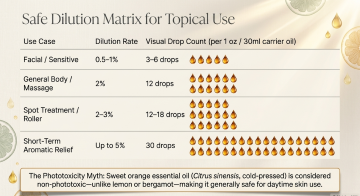
- Facial or sensitive areas: 0.5–1% (3–6 drops per 1 oz / 30ml carrier oil)
- General body or massage: 2% (about 12 drops per 1 oz)
- Spot treatment or roller blend: 2–3% (12–18 drops per 1 oz)
Fractionated coconut oil or jojoba work beautifully as carriers — both absorb well and don’t compete with the scent.
On photosensitivity: cold-pressed citrus oils can cause skin sensitivity in UV light. Here’s something many people don’t know — sweet orange (Citrus sinensis, cold-pressed) is actually considered non-phototoxic, unlike lemon or bergamot. So it’s generally safe for daytime skin use.
That said, check your label. Steam-distilled orange carries even less risk if this is a concern.
For diffusion, 3–6 drops in a standard ultrasonic or nebulizing diffuser is plenty. Diffuse in intervals — 30 to 60 minutes on, 30 minutes off. More isn’t better with citrus; it tips from bright to sharp quickly. Ensure the room is well-ventilated.
For palm inhalation — one drop, rubbed between the palms, cupped over the nose and mouth, three to five slow breaths — this is the method I return to every morning. Immediate. Intimate. Requires nothing but the oil and your hands.
A few important cautions:
- Pregnancy: Sweet orange is generally considered gentle, but use during the first trimester especially should be discussed with your healthcare provider first
- Children under 3: Guidelines recommend limiting aromatherapy to children over age 3, and then only at much lower dilutions
- Pets: Citrus oils are generally irritating to cats. For dogs, occasional diffusion in a well-ventilated space is lower risk — never apply topically. If you have cats, diffuse in a room they can freely leave
- Internal use: Professional aromatherapy organizations strongly discourage internal use without direct clinical supervision
On shelf life: limonene oxidizes faster than most compounds, giving orange a shelf life of roughly one to two years. Fresh orange smells clean, bright, almost juicy. Oxidized orange smells flat — duller, sometimes faintly sharp. Trust your nose — replace rather than push through.
I use Young Living’s orange because I trust the sourcing. Their Seed to Seal process means the oil is cold-pressed from properly cultivated fruit without synthetic additives.
With a simple oil like orange, purity matters more than most people expect.
How to Choose a Quality Oil
This is worth addressing directly, because the essential oil market has a real quality problem.
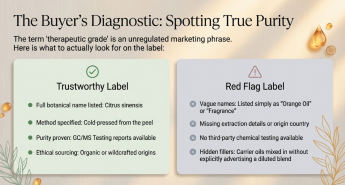
The term “therapeutic grade” sounds reassuring. It isn’t.
There is no regulated, independent body that certifies or grades essential oils using that term. Anyone can put it on a label.
Here’s what to actually look for:
- The botanical name on the label: Citrus sinensis for sweet orange. Sweet orange and bitter orange are different oils with different properties and safety profiles
- Extraction method specified: cold-pressed from the peel
- Country of origin listed: major producing regions include Brazil, the US (Florida or California), Italy, and Spain
- GC/MS testing available: Gas Chromatography–Mass Spectrometry is the gold standard for verifying purity. It identifies every chemical compound and their exact percentages. Reputable companies make these reports available on their websites or upon request
- No synthetic fillers or added fragrance: the ingredient label should list only the essential oil. Watch for “fragrance oil” — a synthetic that won’t provide the same benefits
Some Blends Worth Trying
The Morning Arrival — Diffuser Blend
For: settling in before the day begins
- 3 drops Orange
- 2 drops Frankincense
- 1 drop Cedarwood
Frankincense slows the mind while orange opens it. Cedarwood roots the whole blend. Diffuse before you begin and let it run through your morning.
Intention on the Wrists — Topical Roller Blend
For: a pre-ritual moment of arrival
- 8–9 drops Orange
- 5 drops Cedarwood
- 3 drops Frankincense
- Fractionated coconut oil or jojoba to fill a 10ml roller bottle
Apply to the inner wrists, temples, and base of the neck. Roll between your palms before each use. Approximately a 3% dilution — appropriate for spot application on adults.
The Afternoon Return — Diffuser Blend
For: coming back to yourself mid-day
- 3 drops Orange
- 2 drops Bergamot
- 1 drop Peppermint
When the afternoon loses its shape, this blend finds it again. Bright, clean, just enough mint to sharpen the edges without breaking the calm.
Glowing Skin Facial Oil — Topical Evening Blend
For: brightening and overnight skin support
- 2 drops Orange
- 3 drops Lavender
- 2 drops Frankincense
- 1 oz (30ml) jojoba or rosehip seed oil
Add oils to a dark glass dropper bottle and fill with your carrier. Apply 4–6 drops to clean, slightly damp skin in the evening. Massage in upward circular motions. Patch test on your inner arm 24 hours before facial use.
Room Clearing Spray — Household Use
For: refreshing a space between sessions
- 10 drops Orange
- 5 drops Peppermint
- 1 cup distilled water
- 1 tablespoon witch hazel
Combine in a glass spray bottle. Shake before each use. Mist the air — not surfaces — before you begin.
Questions People Ask About Orange Essential Oil
I’ve heard citrus oils are photosensitive. Does that apply to orange?
Sweet orange (Citrus sinensis, cold-pressed) is actually considered non-phototoxic — unlike lemon or bergamot. That makes it generally safe for daytime skin use. Steam-distilled orange carries even less risk. Check your label for the extraction method, and when in doubt, apply to areas that won’t be exposed to direct sunlight.
Can I use orange during meditation if I find strong scents distracting?
Orange is one of the lighter citrus oils — bright without being aggressive. Start with one drop diffused in a larger space, or try palm inhalation so you control the intensity entirely. Most people who find strong scents distracting find orange sits comfortably in the background rather than demanding attention.
What’s the difference between sweet orange, wild orange, and just “orange” essential oil?
They all come from Citrus sinensis and share the same primary constituents. The differences come down to sourcing, growing conditions, and how the fruit was cultivated. The botanical name on the label is what matters most.
I do my ritual in the evenings. Is orange too stimulating?
Orange is genuinely dual-natured — it lifts mood without the sharp activation of peppermint or eucalyptus. Most people find it works beautifully for evening sessions when paired with something grounding like frankincense or cedarwood. On its own, it’s unlikely to interfere with winding down.
Is orange safe to use around children?
For children over three, sweet orange is one of the more commonly recommended oils — but always at much lower dilutions. For children under three, elevated caution applies. Diffuse in a well-ventilated room and keep sessions short. Never apply topically to very young children without guidance from a qualified healthcare provider.
How do I know if my orange oil has oxidized?
Fresh orange smells clean, bright, almost juicy. Oxidized orange smells flat — duller, sometimes faintly sharp or slightly off. If it doesn’t smell the way it did when you first opened it, that’s your signal. Oxidized citrus can cause skin sensitivity. Replace it rather than push through.
What should I look for on the label when buying orange oil?
Look for the full botanical name (Citrus sinensis), cold-pressed from the peel, country of origin listed, and GC/MS testing reports available. Avoid anything labeled simply “fragrance oil” — those are synthetic and won’t deliver the same benefits.
Does the research on orange oil actually hold up?
Better than most people expect.
- The anxiety and stress reduction evidence is the strongest — multiple peer-reviewed studies show consistent results.
- The antimicrobial research is solid.
- Pain relief and PTSD research are earlier stage but promising.
- The evidence supports what experienced practitioners have been observing for decades.
- It doesn’t prove everything, but it’s enough to take seriously.
Orange is the kind of oil that earns its place quietly. It doesn’t ask for much. One drop, a few slow breaths, and something shifts — in the room, and in you.
Whether you’re building a morning ritual around presence and intention, supporting your skin’s overnight renewal, cleaning your home without harsh chemicals, or simply trying to make the afternoon feel more manageable — orange has a place in all of it.
Four thousand years of use across cultures and continents. A growing body of research. And an aroma that smells, simply, like the beginning of something good.
For more guides, blends, and deep dives into the oils worth knowing, head over to oilsforliving.us — it’s built to be the resource I wished I had when I was starting out.
A quick note before you go: I’m not a doctor or certified aromatherapist — just someone who’s done a lot of reading and a fair amount of experimenting. Nothing in this article should be taken as medical advice. Essential oils are powerful and worth learning about, but if you have a serious health condition, please talk to a qualified healthcare provider. Always dilute before applying topically, and do a patch test first.
— Max