What’s Really Under Your Kitchen Sink — And Why We Switched to Essential Oils
Most people don’t question what’s in their cleaning products. They grab the bottle with the blue liquid, spray it on the counter, wipe it down, and move on with their day. That was us too — for years.
Then someone we trusted took a hard look at what was actually in those bottles. What she found wasn’t just surprising. It was enough to make us completely rethink what “clean” really means.
We’re not here to scare you. We’re here to show you what we found, what we switched to, and why — after 30 years of using essential oils in our home — we’ve never looked back. And honestly? It’s a lot simpler than you might think.
The Problem With “Clean”
Walk down the cleaning aisle of any grocery store and you’ll be hit with a wall of bright colors, bold promises, and words like antibacterial, industrial strength, and kills 99.9% of germs.
It sounds reassuring. It’s designed to.
But here’s the thing: those labels are telling you what the product does — not what it is.
The ingredients doing the heavy lifting in most conventional cleaners are synthetic chemicals that didn’t exist 100 years ago. Your great-grandmother didn’t have them. She kept a clean house without them. And yet today we’ve been convinced that we can’t live without them.
Let’s look at what’s actually common in most homes — and what researchers and everyday people have started paying closer attention to.
The Chemicals Worth Knowing About
Ammonia
Found in: glass cleaners, multi-surface sprays, some floor cleaners
Ammonia is what gives a lot of glass cleaners that sharp, eye-watering smell. It cuts grease and evaporates quickly, which makes it effective. But it’s also a respiratory irritant — particularly for people with asthma or lung sensitivity. Many people notice burning eyes or a scratchy throat when they use it in a small space like a bathroom.
Mixing ammonia with bleach — something that happens accidentally more often than you’d think — produces toxic chloramine gases. That’s not a minor inconvenience. That’s a genuine hazard.
Bleach (Sodium Hypochlorite)
Found in: disinfectants, toilet bowl cleaners, mold removers, laundry products
Bleach is the gold standard of “killing germs” in most households. And it works. No one’s arguing that. But it’s also a corrosive compound that irritates the skin, eyes, and lungs on contact. It breaks down into harmful byproducts and, as mentioned, becomes dangerous when mixed with other common cleaners like ammonia or acids (including vinegar).
Residue left on surfaces — countertops, cutting boards, bathroom tile — doesn’t just disappear. It lingers.
Synthetic Fragrances
Found in: almost everything — cleaners, air fresheners, dryer sheets, fabric softeners, dish soap
This one surprises people the most. The word “fragrance” on an ingredient label is a legal catch-all that can represent dozens — sometimes hundreds — of undisclosed chemical compounds. Manufacturers aren’t required to list them individually because they’re considered proprietary formulas.
Some of these compounds are phthalates, which studies have linked to hormone disruption.
Others are volatile organic compounds (VOCs) that off-gas into the air you breathe long after you’ve finished cleaning. That “fresh clean” smell you love? It’s often a cocktail of synthetic chemicals designed in a lab to trick your nose into feeling good.
Triclosan
Found in: some antibacterial soaps, dish soaps, hand sanitizers (though its use has been restricted in some products)
Triclosan was in everything for a while. It was marketed as the reason to choose antibacterial products over regular ones. The FDA eventually restricted its use in certain soaps after research raised questions about its effects on hormone regulation and its contribution to antibiotic resistance.
It’s worth noting that regular soap and water — no antibacterial agent required — is considered just as effective for everyday handwashing.
Formaldehyde and Formaldehyde-Releasing Preservatives
Found in: some multi-surface cleaners, air fresheners, certain personal care products
Formaldehyde is classified as a known human carcinogen at high exposures. It’s also a common preservative in household products under names that most people don’t recognize: DMDM hydantoin, quaternium-15, imidazolidinyl urea. You won’t see “formaldehyde” on the label — but these compounds release it slowly over time.
“But Don’t We Need These Chemicals to Really Disinfect?”
This is the most common pushback — and it’s a fair one. If you’re used to the idea that only harsh chemicals kill germs, the idea of switching to plant-based alternatives sounds like going backward.
Here’s what’s worth knowing:
Most cleaning tasks in a normal home don’t require disinfection at all. Removing dirt, grime, grease, and everyday bacteria from surfaces is a job that can be done effectively without industrial-strength chemistry. True disinfection — killing pathogens to a clinical standard — is relevant in medical settings, after illness, or in specific high-risk situations. It’s not what your kitchen counter needs on a Tuesday afternoon.
Essential oils have natural antimicrobial properties. This isn’t alternative medicine folklore.
Research has documented the antimicrobial activity of compounds found in several essential oils — particularly tea tree (melaleuca), lemon, eucalyptus, thyme, and oregano. They won’t replace a hospital-grade disinfectant, and we’d never claim they do. But for everyday household cleaning? They’re genuinely effective — and they don’t leave behind a cocktail of synthetic residue.
You don’t have to choose all-or-nothing. If this is new territory for you, you don’t have to throw out everything under your sink today. Start with one swap. See how it works. Go from there.
What Essential Oils Actually Bring to the Table
Essential oils are concentrated plant extracts — the natural compounds that give plants their scent, their ability to resist pests, and their own form of protection. When you use lemon essential oil to clean your counters, you’re using the same compounds the lemon plant produces to protect itself. There’s something fitting about that.
Here’s a quick look at the workhorses of a natural cleaning routine:
Lemon — A natural degreaser. Cuts through grease and grime on kitchen surfaces. Leaves a fresh, clean scent that’s actually fresh — not synthetic. Also works well on sticky residue.
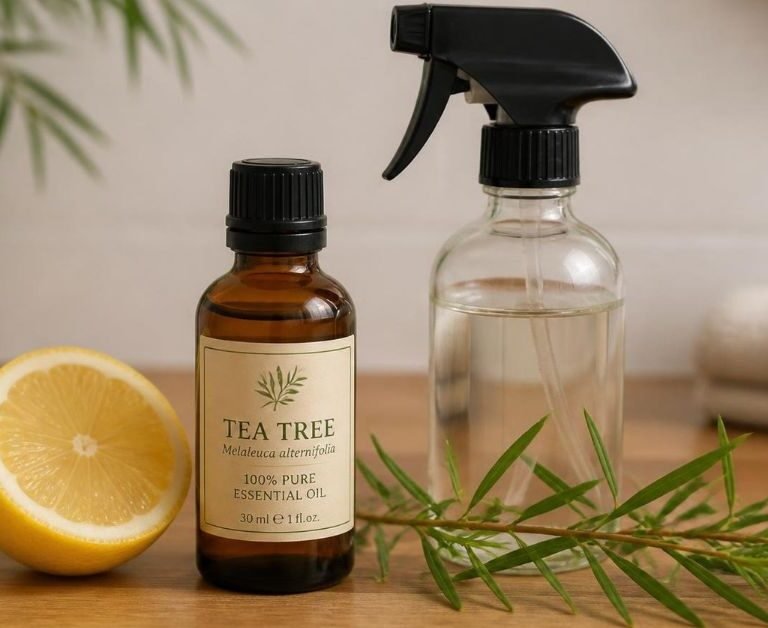
Tea Tree (Melaleuca) — One of the most well-researched oils for antimicrobial properties. What we use when we want extra cleaning power in the bathroom or on high-touch surfaces. It has a medicinal scent that some people love and some don’t — it can be blended with lemon or lavender to soften it.
Lavender — Gentle, versatile, and naturally antimicrobial. Works well in fabric fresheners, bathroom sprays, and anywhere you want a calming, clean scent. It’s also one of the safest oils around kids and pets (always dilute and use with care).
Eucalyptus — A powerful cleaner with a sharp, clean scent. Traditionally valued for its ability to cut through grime and support a fresh-smelling environment. Works well in floor cleaners and bathroom sprays.
Peppermint — A natural insect deterrent that also smells incredible. Many people find it useful along windowsills and entry points. Doubles as a refreshing addition to surface sprays.
Clove and Cinnamon — Warm, spicy, and traditionally used for their antimicrobial properties. Common additions to DIY kitchen and bathroom cleaners.
Side-by-Side: Essential Oils vs. Common Household Chemicals
| Conventional Cleaners | Essential Oil-Based Cleaners | |
|---|---|---|
| Ingredients | Synthetic chemicals, often undisclosed | Plant-derived, transparent |
| Scent source | Synthetic fragrance (proprietary blends) | Natural plant compounds |
| Residue | Chemical residue on surfaces | Minimal, plant-based residue |
| Indoor air quality | VOCs off-gas after use | No harmful off-gassing |
| Mixing risks | Some combinations are toxic (bleach + ammonia) | Safe to combine oils |
| Kid/pet safety | Many require ventilation and careful storage | Diluted oil blends are generally safer (research your specific oils) |
| Cost over time | Recurring purchase of multiple products | Concentrated oils go a long way — one bottle makes many batches |
| Customization | None — you get what’s in the bottle | Blend to your preference, your family, your needs |
| Environmental impact | Synthetic compounds enter waterways | Biodegradable, plant-based |
The Empowering Part: You Get to Be in Control
Here’s what we love most about making the switch — and it’s not about being “crunchy” or “anti-science” or any of that. It’s simpler than that.
When you make your own cleaning products with essential oils, you know exactly what’s in them. Every single ingredient. There’s no proprietary formula. No undisclosed fragrance compounds. No ingredient list that requires a chemistry degree to decode.
That kind of transparency is rare in the consumer product world. And once you experience it, going back to the mystery-bottle approach feels unnecessarily complicated.
The other thing people discover pretty quickly: it’s cheaper.
A 15ml bottle of lemon essential oil contains roughly 250 drops. Most DIY recipes use 20–30 drops per batch of cleaner.
Do the math — that’s a lot of batches from one bottle. Combined with some white vinegar, castile soap, and baking soda (all cheap, all simple), you can replace most of what’s under your sink for a fraction of what you’re currently spending.
DIY Recipes to Get You Started
You don’t need a lot of supplies. Here’s what to have on hand:
- Distilled water — filtered tap water works in a pinch, but distilled lasts longer without going off
- White vinegar — a natural acid that cuts grease and kills many common bacteria
- Castile soap — a plant-based liquid soap (Dr. Bronner’s is widely available) — note: do not mix castile soap and vinegar in the same recipe — the acid deactivates the soap. Use one or the other per recipe.
- Baking soda — gentle abrasive, odor neutralizer
- 16 oz glass spray bottles — plastic degrades with some oils over time; glass is better
- Essential oils of your choice
All-Purpose Kitchen and Surface Spray
Great for countertops, stovetop surfaces, and everyday kitchen cleanup.
What you need:
- 1 cup distilled water
- 1 cup white vinegar
- 15 drops lemon essential oil
- 10 drops tea tree essential oil
- 5 drops lavender essential oil
How to make it: Combine water and vinegar in a 16 oz glass spray bottle. Add essential oils. Shake gently before each use (oils and water will separate slightly between uses — that’s normal).
How to use it: Spray on surface, let sit for 30 seconds, wipe with a clean cloth. For greasy stovetops, let sit 1–2 minutes before wiping.
Note: Do not use on natural stone surfaces like granite or marble — the vinegar’s acidity can dull the finish over time. Use the Castile Soap Spray below instead.
Bathroom and Toilet Spray
Cuts through soap scum, water deposits, and everyday bathroom grime.
What you need:
- 1 cup distilled water
- 1 cup white vinegar
- 20 drops tea tree essential oil
- 10 drops eucalyptus essential oil
- 5 drops peppermint essential oil
How to make it: Combine in a 16 oz glass spray bottle. Shake before each use.
How to use it: Spray on toilet seat, bowl rim, sink basin, and tile. Let sit 1–2 minutes. Wipe or scrub as needed. For the inside of the toilet bowl, apply and let sit 5–10 minutes before scrubbing.
Granite-Safe All-Purpose Spray (Castile Soap Version)
Safe for natural stone, sealed wood, and any surface where vinegar isn’t appropriate.
What you need:
- 2 cups distilled water
- 1 tablespoon liquid castile soap
- 15 drops lemon essential oil
- 10 drops lavender essential oil
How to make it: Add water to a 16 oz glass spray bottle first. Add castile soap slowly (adding soap first causes excessive foaming). Add essential oils. Cap and swirl gently — don’t shake vigorously or you’ll have a foam situation.
How to use it: Spray on surface, wipe clean. For tougher messes, let sit 30 seconds before wiping.
Soft Scrub for Sinks and Tubs
The natural answer to those gritty powder cleansers — without the bleach.
What you need:
- 1/2 cup baking soda
- Enough liquid castile soap to form a paste (roughly 2–3 tablespoons)
- 10 drops lemon essential oil
- 5 drops tea tree essential oil
How to make it: Mix baking soda and castile soap together until you get a thick, spreadable paste. Add essential oils and stir to combine. Store in a small glass jar with a lid.
How to use it: Scoop a small amount onto a damp sponge or cloth. Scrub sink or tub surface. Rinse clean. Use within a few weeks — the baking soda and soap will stay fresh for a while, but it’s best made in small batches.
Linen and Air Freshener Spray
Replace synthetic air fresheners and dryer sheets with this simple spritz.
What you need:
- 1 cup distilled water
- 2 tablespoons witch hazel or rubbing alcohol (helps oils disperse in water)
- 20 drops lavender essential oil
- 10 drops lemon essential oil
- 5 drops eucalyptus essential oil
How to make it: Combine witch hazel and essential oils in a 12–16 oz glass spray bottle. Add water. Shake well before each use.
How to use it: Spritz on pillowcases, bedding, upholstery, curtains, and into the air. Works in closets too. Shake before each use.
How to Make the Switch Without the Overwhelm
We’re not suggesting you overhaul your entire home in a weekend. That’s a recipe for frustration.
Here’s what actually works:
Start with one room. Pick the easiest swap — most people start in the kitchen or bathroom. Make one cleaner. Use it for a week or two. See how you feel about it.
Replace as you run out. Instead of throwing away products you’ve already paid for, commit to making a DIY version the next time a product runs out. One by one, your cabinet shifts.
Keep it simple. You don’t need 30 different oils. Lemon, tea tree, and lavender will cover most of what you need to start. Add from there as you get comfortable.
Trust your nose. One of the most immediate differences people notice when switching to essential oil-based cleaners is how their home smells after cleaning. Not like a chemical factory. Just clean — the way air smells after rain, or a kitchen smells when citrus has been cut.
A Word of Honest Transparency
We believe in essential oils deeply — 30 years of personal experience will do that. But we also believe in being straight with you.
Essential oil-based cleaners are not identical to hospital-grade disinfectants. They’re not intended to be.
For everyday household cleaning, they’re genuinely effective and a meaningful improvement over the chemical soup most of us grew up with. But if someone in your home has a compromised immune system, has been sick, or if you’re dealing with a situation that calls for true clinical disinfection — use the right tool for the job.
What we’re talking about is everyday cleaning. The Tuesday-afternoon counter wipe. The weekly bathroom scrub. The floor mop. The laundry freshen. For all of that, you have a real, plant-based, ingredient-transparent option. And once you try it, most people find they never want to go back.
You Already Have Everything You Need to Start
The chemicals under your sink were never really serving you the way you thought they were. And replacing them doesn’t require a complete lifestyle overhaul or a pantry full of expensive products.
It starts with one spray bottle. A cup of vinegar. A few drops of lemon and tea tree. And the decision to know exactly what’s going into your home.
That decision — small as it sounds — changes things. What you breathe. What touches your skin. What your kids and pets are exposed to. What goes down your drain and into the water supply.
One swap at a time. That’s all it takes.
Want more DIY recipes and natural living ideas delivered to your inbox every week? Subscribe to the Oils For Living newsletter at oilsforliving.substack.com — it’s free, and we keep it practical.